
“Life Is Too Short to Be Shy”: How One Brazilian Immigrant’s Journey From Cancer Survivor to Soft Skills Entrepreneur Reveals London’s Hidden Loneliness Epidemic
2026-03-25 08:41 - By Erica Melargo
“Life Is Too Short to Be Shy”: How One Brazilian Immigrant’s Journey From Cancer Survivor to Soft Skills Entrepreneur Reveals London’s Hidden Loneliness Epidemic
By Erica Melargo
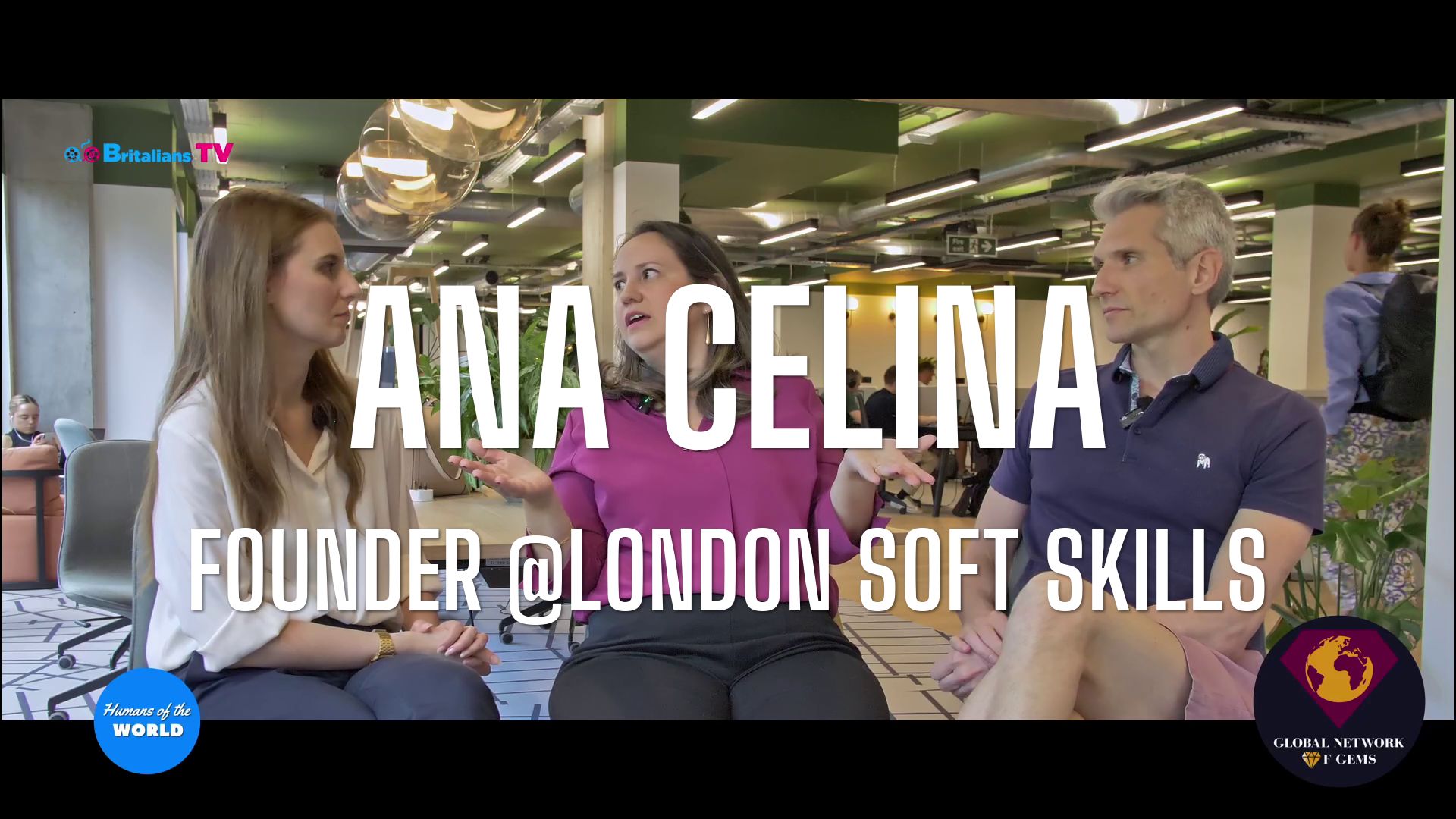
On a quiet stretch of road in north-west London, Ana Celina Fernandes Mutlu sits across from Marco Biagioli and I, dressed in one of her favourite colours — purple. She opens up to share a remarkable story of transformation from cancer survivor to self-made entrepreneur teaching soft skills across London.
What emerges is more than a personal success narrative. Behind Ana Celina’s journey lies a much larger story — one about loneliness, identity loss among many newcomers arriving in London, and whether soft skills can help rebuild human connections in an increasingly fragmented city.
The Woman Who Wasn’t Supposed to Have Children
Ana Celina is her full name; no surname at all. She was born in a small town in Brazil’s northeast before moving as a three year old to Brasília, the modern capital she describes with genuine warmth: “It’s clean, it’s safe, it’s beautiful.” There she grew up in what she calls a highly united family of four siblings — always led by their parents, her father an extroverted negotiator and diplomat in all but title, her mother a tireless public relations machine hosting parties for family, friends, and anyone who needed a place at the table.
That foundation shaped everything, though Ana herself was very different. Shy, introverted, she found comfort in delicate crafts like mosaic work — “it’s my therapy,” she says — and originally planned to study dentistry at university because it demanded precision and small-scale perfectionism. Something changed during a voluntary social project in high school, where she witnessed an educator doing everything: mentoring students, coordinating volunteers, cleaning up.
“She was like my maestra,” Ana Celina explains to us.
That moment of connection redirected her life. She left dentistry for education, eventually passing Brazil’s competitive public examinations and landing a role at Eletrobras, Latin America’s largest energy company. There she trained thousands of employees — hard skills alongside soft ones. But before any of that could happen, life dealt her what would prove the hardest lesson of all.
Stage Four Lymphoma: The Turning Point That Opened Eyes and Windows
In 2015, barely a month after walking out of a check-up, Ana Celina discovered an unusual lump on her breast. At stage four lymphoma. In less than thirty days, she went from perfectly healthy to undergoing eight cycles of intensive chemotherapy, with each treatment cycle lasting five days. She was not yet married. Not yet in London.
The experience reshaped her fundamental outlook. Sitting shaved-headed and alone during treatments, looking out at other windows in the hotel where she stayed between sessions, Ana Celina says something that strikes deep for anyone living a solitary life in London: “We have no idea what happens behind that window.” An unseen person is living through an unseen story.
But people came. Strangers on the street, who saw her bald head and knew without asking. Some shared their own stories of survival. Others simply offered strength. These encounters ignited something permanent: “I started doing this to anyone in the world.” She says that good words and support are powerful tools for health, for mental well-being, for resilience.
The cancer fundamentally shifted Ana Celina from introversion into what Marco Biagioli calls being incredibly magnetic. The woman who avoided conflict learned that life is too short for shyness, for holding back. “I took out the shyness,” she explains with a laugh.
Broader Context: Loneliness in London’s Displaced Population
Ana Celina’s reflections behind those hospital windows resonate with a far wider crisis. The UK Office of National Statistics reports that more than three million adults in the United Kingdom say they feel often or very often lonely — up significantly since 2020 (ONS, May 2025). In London alone, where transient populations and high costs force communities apart, expatriates and people building a new life in London are disproportionately affected. Many find themselves without the safety net of nearby family, without even two hundred close friends to call upon when crisis hits.
I raised this directly with Ana during our conversation, pointing out the contrast she draws between having a deep network in Brazil versus rebuilding from zero in London — especially while pregnant and remote-working, then maternity leave at home with an infant. What happens when an immigrant who previously had everything starts over? How many others are silently struggling behind closed windows?
Soft Skills As Survival Skills
Ana Celina rebuilt herself methodically around what she believed in most deeply: that soft skills aren’t supplementary to professional life, they constitute how we live. Leadership, conflict mediation, empathy, emotional intelligence — “Soft skills is life,” she says emphatically at one point during the interview. Everyone needs them, not just employees sitting in boardrooms.
She trained formally in gamification, a methodology that uses structured play, physical activities, and game-based simulations to surface behavioural insights. Rather than reading about empathy or teamwork, participants embody these skills through exercises like building structures from maps — something she even demonstrated with her Turkish husband at home, revealing how miscommunication happens when instructions lack clarity. Her company dolphins became their domestic teaching aids.
When Eletrobras was privatized in Brazil, Ana Celina was offered redundancy. It arrived at the exact moment London had begun changing her mindset. She tried applying for jobs. One opportunity required a five-hour daily commute involving ferries to an island outside the country, and she paused. What if instead of waiting for someone else to offer her a role that fits?
“I just opened something,” she says simply about launching her own soft skills training business. “Instead of waiting someone, you do it yourself.” And when her one year old daughter now attends nursery three days per week, those are the exact three days Ana Celina runs her business — because motherhood and entrepreneurship demand intentionality.
Three Lessons From a Woman Who Learned to See Mountains Rather Than Peaks
The interview circles back to one question Marco Biagioli poses near its end: what’s the single soft skill that Ana wants people walking away with long after their training has ended? She names three, though she insists they’re intertwined.
First, communication. She calls it the base of all soft skills: without it, nothing else happens. Second, connection — because communicating is ultimately about connecting to other human beings. Third, which she says reveals everything about what makes London work as a city, is intersection. London, Ana Celina explains, is a school of humanity. It draws people from every culture, every language, every background. The question isn’t “what’s different between us?” but rather “what connects at the intersections?”
She points to rare corporate partnerships — Nike partnering with Levi’s for the first time ever, companies cooperating instead of competing — and argues this mirrors what individuals must do daily. Without connecting across differences, without sharing energy toward common ground, communities fracture. With it, cooperation emerges effortlessly, because humans, she insists fundamentally want to be together. We don’t want to fight.
Perhaps the most revealing soft skill Ana Celina herself credits for getting her through chemotherapy is something called systemic view — the ability to zoom out and see any single crisis as one peak along a mountain range rather than the entirety of the landscape. The chemo was hard, but it wasn’t everything. Right now, business challenges feel huge, but they’re not everything either.
“The challenge is just one point,” she says. “Look at the whole.”
What Ana Celina’s story reveals about loneliness in London and London’s Immigrant Community
Ana Celina’s story — from confident professional in a stable Brazilian state enterprise to cancer survivor rebuilding identity, career, marriage, and motherhood abroad while founding her own business — illuminates several threads running through London’s Portuguese-speaking community specifically:
The burden of leaving everything. Ana gave up permanent tenure at one of Latin America’s largest corporations because she trusted love. Her husband was already in London. That gamble carries immense weight, especially when you consider the isolation that followed during maternity leave and early business-building days. Not everyone has that safety cushion. Local community centres report increasing demand for support among newly arrived Portuguese-speaking families who find themselves without employment networks on landing.
The importance of voluntary work as a pathway to belonging. Ana consistently frames volunteering not only as giving help but as receiving development. During her high school years in Brazil, the volunteer project redirected her entire career trajectory. She recommends it for young people today precisely because those environments develop soft skills in ways paid employment never will. This aligns with broader social research showing that volunteering helps newcomers settle into the UK, significantly boosting community integration and reducing isolation during their first twelve months
The redefinition of self through hardship. Ana’s transition from introvert to extrovert after stage-four cancer treatment is not unusual among survivors. Medical psychology literature documents what’s called post-traumatic growth — wherein individuals report increased empathy, stronger social connections following serious illness. What makes her case distinctive is how she channelled that personal transformation into a professional mission: training others to connect, communicate, and find intersection across differences.
Why loneliness in London matters to local communities
This isn’t solely Ana Celina’s story. Across London — indeed across the United Kingdom — an estimated 4.3 million people aged sixty-five or older live alone. Among younger demographics, those without children report higher rates of social isolation. Expatriates face compounded risks when they lack both geographic and linguistic proximity to extended family networks.
Meanwhile, employers increasingly recognise soft skills deficits as a drag on productivity. Industry research highlights a growing soft skills crisis across the UK workforce, with business leaders routinely ranking communication and human-centred leadership among their most critical talent shortages. Gamification-based training programs like the one Ana pioneered at Eletrobras are gaining traction precisely because they bypass passive learning models — participants don’t read about empathy; they feel it through structured exercises and debriefs.
The convergence of these trends means that people like Ana Celina occupy a critical space: trained educator, cancer survivor, immigrant mother running her own business, she sits at exactly one of London’s intersections, bridging professional training with lived experience of vulnerability, loss, and rebuilding.
Looking Ahead
When I asked what’s next for the next five to ten years, Ana doesn’t have a fixed plan. She compares herself to someone swimming through a mountain climb — each moment presents different terrain, different views. But she has a clear intention: reaching more people. “I want to touch as many souls as possible,” she insists with genuine emotion. Communication, connection, intersection.
It’s worth remembering that in 2015 doctors told her she might never have children following chemotherapy. Today, Ana Celina has a one year old daughter whom she describes as sweet and remarkably social, despite the medical odds. She speaks fondly of how her mother came to London for the birth, providing crucial support during those first two months at home.
She lives proof that systemic view works — the terrible things don’t cancel out what follows. The cancer led to purpose rather than despair. Losing a secure career in Brazil opened an entrepreneurial path here. Being away from family taught her how vital connection really is. Each loss seeded something new.
As we ended our conversation with Ana Celina on this beautiful London day, we agreed on what matters most: that knowledge truly is liberation when it enables recognition of the people around you, within yourself.
Ana Celina’s experience highlights a challenge affecting thousands of people across London. Behind every new business, every recent arrival and every family rebuilding their lives lies the same question: how do we create genuine human connection in one of the world’s busiest cities? Her answer is simple—through communication, empathy and the willingness to reach out before loneliness takes hold.
Written by
Erica Melargo
In this Article
Global Network of Gems
In this Article



News
10 December 2021
“I sent my Résumé to NASA every week for a year”: Meet Aerospace Engineer Thomas Ivanco
2026-03-25 08:41:20
“Life Is Too Short to Be Shy”: How One Brazilian Immigrant’s Journey From Cancer Survivor to Soft Skills Entrepreneur Reveals London’s Hidden Loneliness Epidemic
21 February 2022
“You cannot change the past, but only you can change the future!”
16 January 2025
“I Wanted to Help People”: Deputy Supervisor Rick Marsh of Tuxedo, the Gem of New York, on Humans of the World with Marco and Erica
30 November 2021
“Il cielo è il limite e tu sai che puoi avere / Quello che vuoi, sii quello che vuoi”.

31 August 2021
“SIAMO TUTTI SULLA STESSA MUCCA”
30 July 2021
“Tu non puoi cambiare il passato, ma tu solo puoi cambiare il futuro!” Primo piano di aspirazioni e obiettivi del fotografo Arnt Eriksen.
2 July 2021
#TRUELIFE: Marco and Erica spotted at DAM Health Covid-19 Test centre
2 July 2021
#TRUELIFE: Marco ed Erica di nuovo in viaggio!

24 December 2021
61 Motivi per Trasferirti all’Estero
24 December 2021
61 Reasons Why You Should Move Abroad
8 November 2021
A Britalian in Rome: the actress Jane Alexander
16 July 2021
A caccia di aurore boreali
29 January 2023
A Chocolate Extravaganza In Vermont- Humans of the World third Season Flies Across The Pond
15 November 2024
A Conversation with Dr. Markus Naser: The Unlikely Mayor of Rothenburg ob der Tauber
15 November 2024
A Day in the Life of Oliver Gußmann: Rothenburg's Tourist Pastor
15 November 2024
A Glimpse into the Life of Laura: Embracing Family, Theater, and Cultural Diversity
23 July 2021
A journey into the atelier of Cipessa Prin

6 July 2022
A Miniature Artist Explains to Marco and Erica How to Put Things into Perspective
17 January 2022
A talent in… Nashville!