
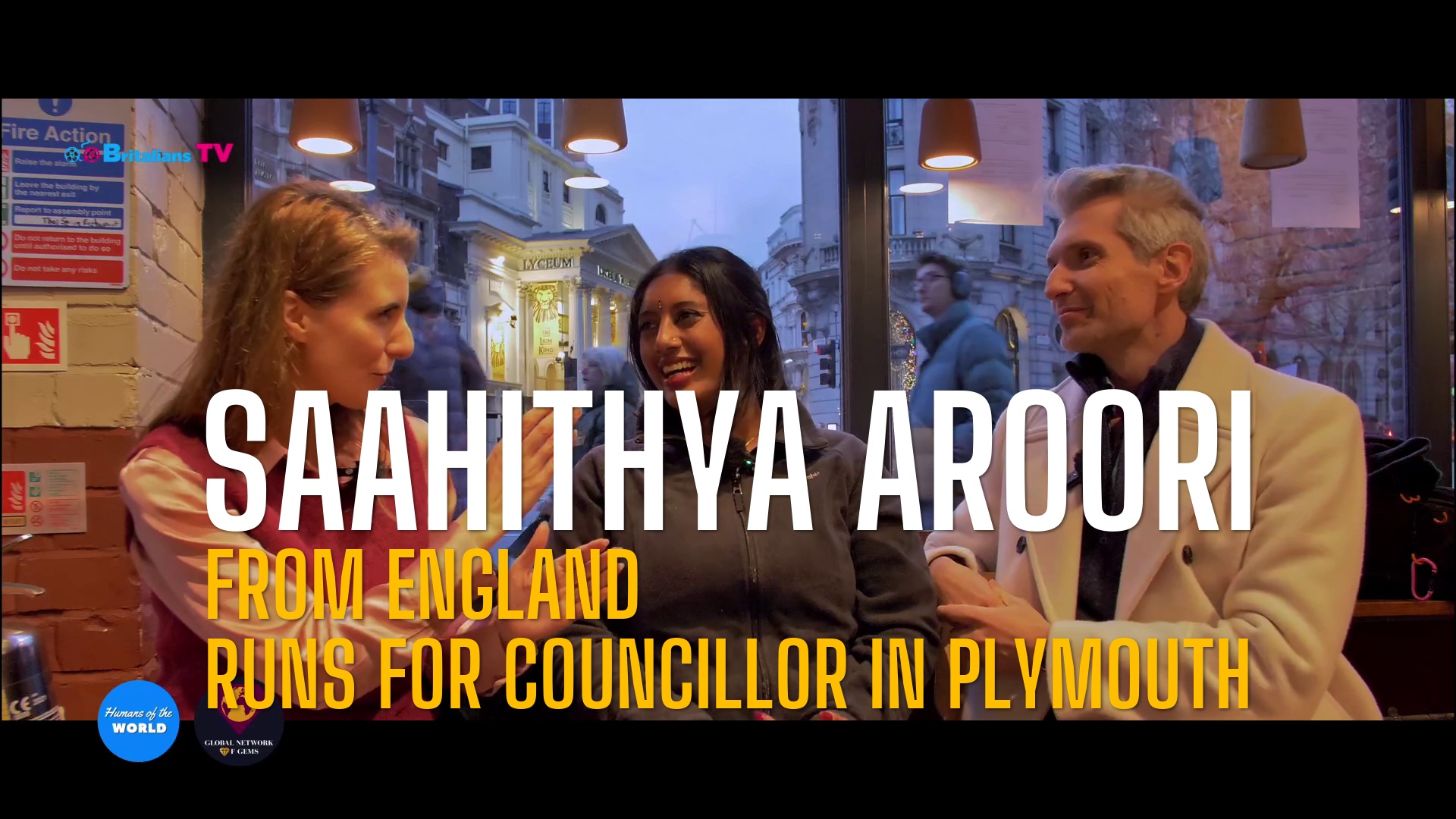
Plymouth Local Elections: Why 22-Year-Old Saahithya Aroori Is Campaigning for Her Community
2 January 2026 - By Erica Melargo
Plymouth Local Elections: Why 22-Year-Old Saahithya Aroori Is Campaigning for Her Community
By Erica Melargo (Britalians TV | Local Democracy & Community Affairs)
This encounter began with a simple question on a busy London street: “Do you need something?” For Saahithya Aroori, the 22-year-old environmental policy graduate, it was a catalyst. Months later, she’s trading academic research for doorstep campaigning, vying for a seat in Plymouth’s May local elections. But her bid is unfolding against a backdrop of long-standing municipal underinvestment, rising nationalist symbolism, and a personal reckoning with what it means to represent a city that has yet to fully make space for voices like mine.
When Marco and I first sat down with Saahithya, our conversation quickly moved from street-level encounter to systemic observation. What emerged was not just a personal campaign narrative, but a window into three intersecting challenges shaping British local democracy today: the legacy of austerity-driven community neglect, the polarization fueled by exclusionary symbolism, and a growing demand for environmental policy that treats ecological health and social equity as inseparable.
Representation Gaps and the Courage to Run
Saahithya, who identifies as ethnically Indian, was born and raised in Plymouth. Her grandparents remained in India, and she speaks Telugu at home. Growing up, Saahithya says she rarely saw candidates who shared her background on local ballot papers or at council meetings. “I’ve never felt empowered in my life as a Brown woman that I could be in a political space,” she told us during our interview. That hesitation is common among minority youth entering civic leadership, despite recent national shifts: the 2024 UK general election saw record numbers of under-35 candidates, and local authorities are increasingly treating grassroots participation as essential to rebuilding public trust.
Yet empowerment requires navigating internal barriers. “The biggest challenge for me is actually myself,” Saahithya admitted, referencing the intimidation of digital campaigning and the fear of being judged before she’s heard. Marco noted during our exchange that many first-time candidates struggle with imposter syndrome when stepping into spaces historically guarded by established networks. Her response underscores a broader democratic imperative: local government must lower barriers to entry if it hopes to reflect the populations it serves. Her campaign, launched between jobs and fueled by post-graduation momentum, reflects a new model of civic engagement—one where representation isn’t inherited, but claimed.
Austerity’s Shadow and the Fractured Community
Saahithya’s central critique points to a well-documented reality: “The people of this country have been genuinely neglected.” Since 2010, UK local authorities have faced cumulative budget reductions exceeding 40% in real terms, according to Institute for Fiscal Studies data. Plymouth City Council, like many post-industrial coastal municipalities, has absorbed cuts across youth services, housing support, and community infrastructure. Research from the Joseph Rowntree Foundation links these reductions to rising social fragmentation, declining institutional trust, and heightened economic anxiety.
“They’ve been given an enemy,” Saahithya observed during her conversation with Marco, describing how political narratives often pit residents against migrants or cultural outsiders rather than addressing systemic failures. This dynamic echoes across towns where economic transition has outpaced reinvestment. Yet the response on the ground is not monolithic. Plymouth’s faith networks, mutual aid groups, and youth councils have been quietly rebuilding social cohesion, emphasizing that shared struggle often bridges divides more effectively than rhetoric. Her comments highlight a wider challenge facing many communities: addressing service gaps requires coordinated funding, transparent prioritisation and sustained dialogue with residents who have felt sidelined by decision-makers.
Flags, Fear, and the Battle for Civic Space
Perhaps the most visceral challenge Saahithya faces is the changing visual landscape of her neighborhood. She pointed to a surge in prominent British flags—a phenomenon tied to grassroots movements like “Raise the Flag,” which advocates for national symbolism but has been criticized by community organizations for occasionally intersecting with exclusionary politics. Knocking on doors amid this backdrop, Saahithya described moments of uncertainty: “Do they think I don’t belong here? Do they think we need to change the British flag?”
Her concern raises a broader question about civic space: who gets to claim it, and whose identity is deemed compatible with local belonging? Researchers at the Runnymede Trust note that while patriotism itself isn’t inherently divisive, its weaponization can chill political participation, particularly for minority candidates. Marco gently pressed on this during our discussion, noting how fear of the unfamiliar often masks deeper anxieties about change. Saahithya’s response was characteristically grounded: “It’s not people’s fault. I think people in this country have been neglected.”
Rewilding Communities: Where Environment Meets Equity
Beyond the ballot box, Saahithya’s policy vision bridges ecology and social cohesion in ways that reflect contemporary shifts in environmental governance. As a recent Master’s graduate in environmental economics, she argues that treating nature as separate from human communities has enabled exploitation of both. “We are part of nature,” she told us, advocating for ecological literacy rather than token green initiatives.
Her critique of “curated” parks versus wild habitats aligns with growing momentum around Nature Recovery Plans and Biodiversity Net Gain mandates now embedded in UK planning law. Plymouth’s coastline, river corridors, and surrounding moorlands offer significant potential for habitat restoration, yet funding gaps and development pressures complicate implementation. Environmental justice scholars emphasize that marginalized communities often bear the brunt of ecological degradation while having the least say in land-use decisions. Saahithya’s approach flips this script: she envisions environmental policy not as a technical silo, but as a community-building tool. “Looking after the environment and people—it’s good,” she said. “They are not two separate things.”
What Comes Next
When Marco and I wrapped up our conversation, we did what Britalians TV always does: treat the interview not as an endpoint, but as an entry point. Saahithya’s story resonates far beyond Plymouth’s council wards. It speaks to a generation demanding representation that mirrors the communities they serve, and to cities grappling with how to invest in both people and place after years of disinvestment.
As May approaches, she will be knocking on doors, distributing leaflets, and testing her platform against real-world skepticism and hope alike. The outcome of her campaign may hinge on turnout, funding, or electoral dynamics—but its significance lies elsewhere. It’s a reminder that local democracy thrives not when it echoes the loudest voices, but when it makes room for those who’ve historically been told to wait their turn.
Whatever the outcome at the ballot box, Saahithya’s campaign reflects broader questions facing Plymouth: who participates in local democracy, how communities rebuild trust after years of financial pressure, and how environmental policy can be linked with everyday life. Those questions will remain long after the election has passed.
Written by
Erica Melargo
Episodes in this Article

London ► S12 E22
Saahithya Aroori From England runs for Councillor in Plymouth
In this Article

Global Network of Gems
Featuring


Marco Biagioli
Actor and TV Presenter


Erica Melargo
Actor and TV Presenter
In this Article

News
10 December 2021
“I sent my Résumé to NASA every week for a year”: Meet Aerospace Engineer Thomas Ivanco
2026-03-25 08:41:20
“Life Is Too Short to Be Shy”: How One Brazilian Immigrant’s Journey From Cancer Survivor to Soft Skills Entrepreneur Reveals London’s Hidden Loneliness Epidemic
21 February 2022
“You cannot change the past, but only you can change the future!”
16 January 2025
“I Wanted to Help People”: Deputy Supervisor Rick Marsh of Tuxedo, the Gem of New York, on Humans of the World with Marco and Erica
30 November 2021
“Il cielo è il limite e tu sai che puoi avere / Quello che vuoi, sii quello che vuoi”.
31 August 2021
“SIAMO TUTTI SULLA STESSA MUCCA”
30 July 2021
“Tu non puoi cambiare il passato, ma tu solo puoi cambiare il futuro!” Primo piano di aspirazioni e obiettivi del fotografo Arnt Eriksen.
2 July 2021
#TRUELIFE: Marco and Erica spotted at DAM Health Covid-19 Test centre
2 July 2021
#TRUELIFE: Marco ed Erica di nuovo in viaggio!

24 December 2021
61 Motivi per Trasferirti all’Estero
24 December 2021
61 Reasons Why You Should Move Abroad
8 November 2021
A Britalian in Rome: the actress Jane Alexander
16 July 2021
A caccia di aurore boreali
29 January 2023
A Chocolate Extravaganza In Vermont- Humans of the World third Season Flies Across The Pond
15 November 2024
A Conversation with Dr. Markus Naser: The Unlikely Mayor of Rothenburg ob der Tauber
15 November 2024
A Day in the Life of Oliver Gußmann: Rothenburg's Tourist Pastor
15 November 2024
A Glimpse into the Life of Laura: Embracing Family, Theater, and Cultural Diversity
23 July 2021
A journey into the atelier of Cipessa Prin

6 July 2022
A Miniature Artist Explains to Marco and Erica How to Put Things into Perspective
17 January 2022
A talent in… Nashville!