
How Grief, Heritage and the Search for Authenticity Are Shaping a New Wave of Intentional Travel
2026-02-17 11:02 - By Marco Biagioli
How Grief, Heritage and the Search for Authenticity Are Shaping a New Wave of Intentional Travel
By Marco Biagioli
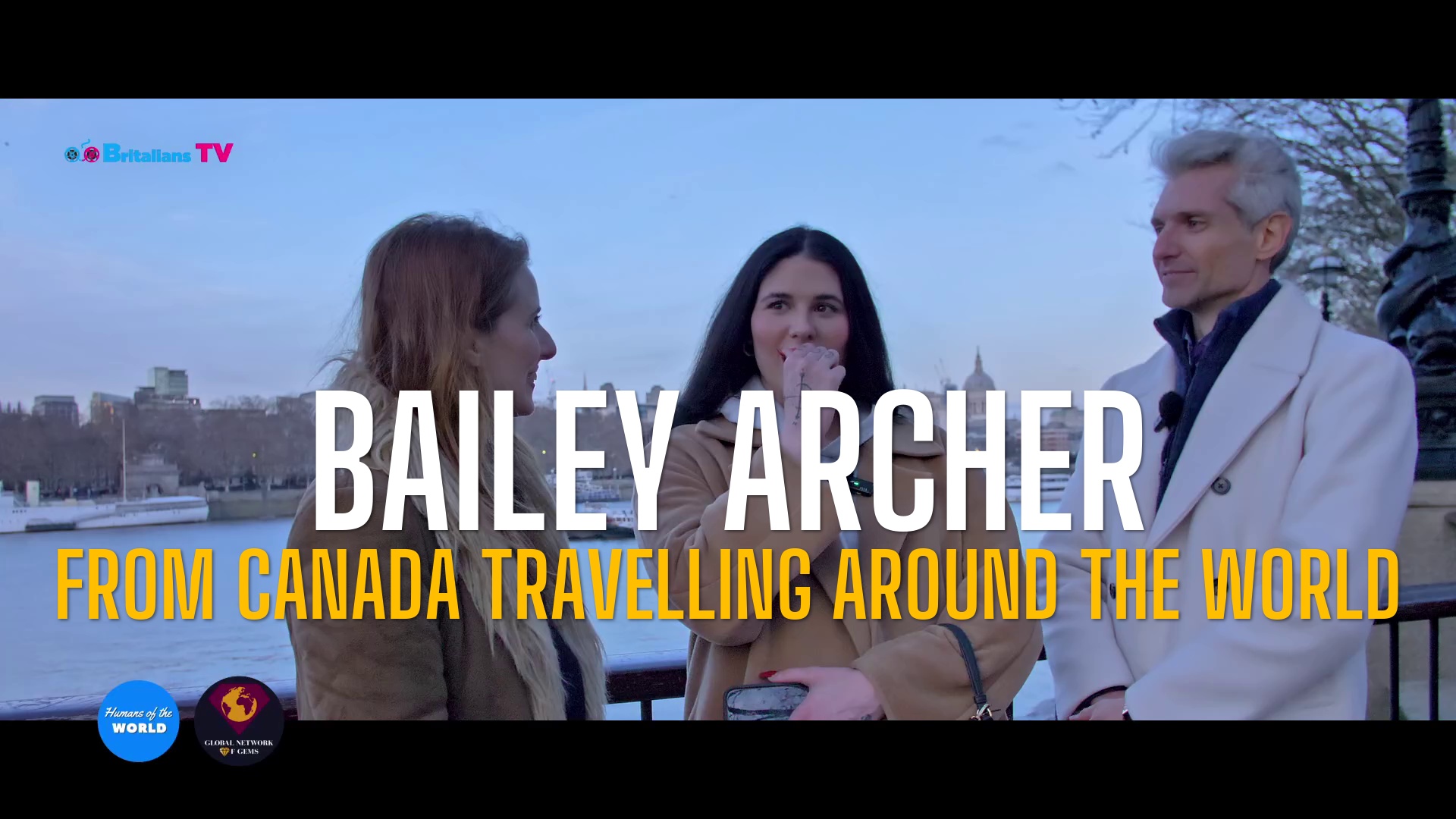
The conversation began, like all my stories at Britalians TV, with a simple question about time. When I asked Bailey Archer how long she prefers to stay in one place before moving on, her answer was immediate: “Probably about a week. After that, you start living there instead of being a tourist.”
That offhand remark quickly unraveled into something far deeper for me personally. Over the course of an interview recorded in London during those final days before she headed home, Bailey—a 25-year-old personal contractor and media creator originally from Toronto—spoke openly about navigating grief, redefining work in a contract-driven economy, holding onto Italian heritage across three continents, and building a life that prioritizes presence over permanence.
For Erica Melargo and me, who use conversation as the foundation for journalism at Britalians TV, interviews are never the finished story; they are catalysts. What emerged from Bailey’s reflections is not simply a personal travelogue, but a window into how young professionals across London, Europe, and North America are recalibrating how they move through the world, build identity, and measure success in an era marked by economic precarity, digital saturation, and collective uncertainty.
1. Travel as Therapy: The “Carpe Diem” Shift in Urban Mobility
Bailey’s recent jaunt across Paris, Brussels, Amsterdam, and London wasn’t conceived around monuments or itineraries; it was born from loss. Earlier this year, her older sister passed away, triggering what she described as a sudden clarity for me: “Life can be so short… you never know what’s going to happen from one day to the next.” She referenced global tragedies, including a fatal terrorist attack in Australia targeting a Jewish community during Hanukkah, serving as sharp reminders that tomorrow is rarely guaranteed.
“I needed to get out of my comfort zone now rather than later,” Bailey told me. “It can be so therapeutic. It helps you reconnect with yourself, reconnect with life.”
Her experience mirrors a documented shift I am seeing in post-pandemic travel behavior. According to recent tourism and mental health research, an increasing segment of millennials and Gen Z travelers are moving away from checklist tourism toward what academics call “intentional mobility”—travel chosen specifically for psychological reset, identity exploration, or grief processing. Public health data across the UK and Canada indicates rising anxiety and burnout among 20- to 35-year-olds, with many reporting that short, unstructured trips offer measurable relief compared to traditional vacations.
However, this trend is not without its challenges. Travel therapy can quickly become financial strain or displacement avoidance if it isn’t grounded in sustainable planning for us. I believe understanding whether Bailey’s approach reflects a wider cultural response requires consulting clinical psychologists specializing in grief and mobility, alongside travel economists tracking the rise of “soft life” tourism. Yet, community responses are already visible: London-based wellness hubs and diaspora-led collectives are piloting structured retreats that pair movement with mental health support.
2. Threads Across Oceans: Heritage as an Anchor in the Diaspora
While Bailey’s travels span continents, her sense of direction consistently circles back to one place: Italy. She often spoke fondly of her nonna, who emigrated from a snow-dusted village in northern Italy and now lives in Halifax, Nova Scotia. “She’s been a very big influence… she taught me to take risks, not give a f*** about what other people say as long as you’re not hurting anybody,” Bailey shared with such conviction. This year, stitching traditional baby blankets for her new nieces feels like carrying on that legacy—passing down embroidery techniques that have survived migration, time, and language shifts.
Her words resonate with a quiet but powerful movement within the British-Italian community. UK census data confirms that second- and third-generation Italian-British individuals are increasingly seeking ancestral reconnection—not solely through tourism, but through skill transmission, culinary preservation, and intergenerational storytelling. London’s Italian Quarter and Toronto’s Little Italy serve as living archives where language, craft, and food practices fiercely resist cultural erosion.
Bailey’s desire to eventually live in Rome or rural Italy, which Erica beautifully captured for me, feels less like pure nostalgia and more like a form of cultural stewardship. When you disconnect from everything you were born from, I think you realize that the act is about rebuilding yourself. We could use oral histories from Italian-British artisans, chefs, and cultural historians to track how heritage practices are adapting to digital globalization.
3. The Authenticity Economy: Contract Work, Creator Culture and the AI Backlash
Bailey works as a personal contractor—a role she accurately described for me as “technically self-employed, but working for a larger company, kind of like a fancy Uber.” Alongside her contracted gigs, she creates media content centered on behind-the-scenes professional life and unfiltered daily moments. Her guiding principle through it all is authenticity.
“With technology today, you’ve got so much AI going on that you don’t know if you’re talking to a real person,” she told me pointedly. “I want people to see me engaging with them authentically. Connection is key.”
Her stance aligns perfectly with industry reports showing creator economy audiences increasingly demanding transparency amid algorithmic fatigue and AI-generated content saturation. In the UK, where nearly 15% of the workforce participates in gig or contract arrangements, young professionals are juggling financial flexibility with career instability. Bailey’s admission that “there’s no guarantee in any job” reflects a broader labor reality to me: employment security has been replaced by adaptability, and success is increasingly measured by sustainability rather than just scalability.
Any follow-up I suggest includes speaking with UK-based labor economists, platform policy analysts, and creator union representatives; we need to map out how contract workers are navigating income volatility while simultaneously demanding ethical content standards. The response landscape itself is shifting: platforms are verifying human creators, brands favor micro-influencers over pure algorithm magic, and worker cooperatives are emerging to provide collective bargaining power for independent contractors.
4. Finding Direction in a Compassless Age: Relationships, Rituals and Self-Reliance
Perhaps the most revealing moment came when Bailey pointed to her “True North” compass tattoo. She explained its origin—it marked past reckoning, present grounding, and future intentionality after she was cheated on during her first serious relationship.
This personal mythology resonates with wider cultural currents I find so compelling. Dating norms among young professionals have steadily decoupled from traditional milestones for me. Bailey views partnership as an “addition, not a necessity,” preferring casual coffee walks over elaborate dinners early in a relationship. Values like respect, humor, and authenticity consistently ranked higher than status or spontaneity when she spoke of it.
Sociological studies confirm this shift: solo living is at historic highs across major cities, driven not by isolation but by intentional independence. Young adults prioritize mental bandwidth and self-directed growth before committing to romantic partnerships. The challenge lies in balancing that self-reliance with community connection; the emergent response is a rise in “platonic intimacy” networks, interest-based clubs, and low-pressure dating cultures that reject performative romance.
Why This Story Matters to My Community
Bailey Archer’s journey from Toronto through Europe to London is far more than a travel diary for me. It’s a cross-section of contemporary urban life: how grief reshapes priorities, how heritage spans generations, how work adapts to instability, and how connection is redefined in an age of digital noise. For Britalians TV, conversations like this are never endpoints; they are invitations for us all to look deeper.
Bailey’s story perfectly demonstrates that personal reflection often points directly to systemic questions. What policies need support for the mental health of young travelers? How can diaspora communities preserve their craft without commodifying it? What protections must exist for contract workers in the creator economy? And crucially, how do our cities foster spaces where people can rebuild direction after inevitable loss?
I feel that to answer these, we need to expand this narrative with verified public data and expert consultation—bringing in travel therapists, Italian-British cultural historians, gig-economy advocates, and urban sociologists. The goal is not to generalize Bailey’s experience, but to contextualize it for the entire community: to show how one person’s compass can help a neighborhood navigate its own shifting terrain.
Life offers no guarantees, as Bailey reminded us. But in a city like London, where migrants, returnees, and newcomers constantly rewrite what it means to belong, I believe the very act of moving forward—intentionally, authentically, and with roots held lightly—is itself an immensely powerful form of community building. And that is a story worth watching.
Written by
Marco Biagioli
Episodes in this Article
London ► S12 E15
Bailey Archer From Canada travelling around the world
In this Article

Global Network of Gems
Featuring


Marco Biagioli
Actor and TV Presenter


Erica Melargo
Actor and TV Presenter
In this Article
News
10 December 2021
“I sent my Résumé to NASA every week for a year”: Meet Aerospace Engineer Thomas Ivanco
2026-03-25 08:41:20
“Life Is Too Short to Be Shy”: How One Brazilian Immigrant’s Journey From Cancer Survivor to Soft Skills Entrepreneur Reveals London’s Hidden Loneliness Epidemic
21 February 2022
“You cannot change the past, but only you can change the future!”
16 January 2025
“I Wanted to Help People”: Deputy Supervisor Rick Marsh of Tuxedo, the Gem of New York, on Humans of the World with Marco and Erica
30 November 2021
“Il cielo è il limite e tu sai che puoi avere / Quello che vuoi, sii quello che vuoi”.

31 August 2021
“SIAMO TUTTI SULLA STESSA MUCCA”
30 July 2021
“Tu non puoi cambiare il passato, ma tu solo puoi cambiare il futuro!” Primo piano di aspirazioni e obiettivi del fotografo Arnt Eriksen.
2 July 2021
#TRUELIFE: Marco and Erica spotted at DAM Health Covid-19 Test centre
2 July 2021
#TRUELIFE: Marco ed Erica di nuovo in viaggio!

24 December 2021
61 Motivi per Trasferirti all’Estero
24 December 2021
61 Reasons Why You Should Move Abroad
8 November 2021
A Britalian in Rome: the actress Jane Alexander
16 July 2021
A caccia di aurore boreali
29 January 2023
A Chocolate Extravaganza In Vermont- Humans of the World third Season Flies Across The Pond
15 November 2024
A Conversation with Dr. Markus Naser: The Unlikely Mayor of Rothenburg ob der Tauber
15 November 2024
A Day in the Life of Oliver Gußmann: Rothenburg's Tourist Pastor
15 November 2024
A Glimpse into the Life of Laura: Embracing Family, Theater, and Cultural Diversity
23 July 2021
A journey into the atelier of Cipessa Prin

6 July 2022
A Miniature Artist Explains to Marco and Erica How to Put Things into Perspective
17 January 2022
A talent in… Nashville!